


Yarn Out 3D
Unico Studio
I spent time with Yarn Out 3D as a casual puzzle game, and my first impression was easy to understand: it takes the familiar idea of untangling loops and turns it into a small three-dimensional logic challenge. The goal is not to rush through action stages or learn a complicated control system. Instead, I look at a crowded arrangement of yarn, work out which loop can move safely, and gradually clear the structure without creating a worse blockage.
That simple premise gives the game an inviting first-week appeal. It is the sort of title I can open while waiting for an appointment, during a short break, or when I want something more engaging than scrolling but less demanding than a full strategy game. Unico Studio keeps the presentation focused on the puzzle itself, which makes the game approachable for players who enjoy visual organization, spatial reasoning, and the satisfaction of turning clutter into order.
The game is free to start and is rated for Everyone, so it is easy to recommend as a low-pressure option for families or for someone who normally avoids complicated puzzle games. It does include optional in-app purchases ranging from $0.99 to $99.99 per item, which is worth remembering before handing the device to a child or treating the game as completely cost-free.
How the untangling puzzles feel in everyday play
The strongest part of the opening experience is the clarity of the central task. A pile of colorful yarn loops looks messy at first, but the mess is readable: I can inspect the visible paths, identify what seems loose, and decide whether moving one piece will expose another. That creates a pleasant rhythm of observation, action, and correction. The best moments are not about speed; they come from noticing a relationship I missed a few seconds earlier.
Three-dimensional presentation also changes how I approach each board. In a flat matching game, I usually scan rows, columns, or obvious groups. Here, I have to think about overlap and visibility. A loop that appears available may still be connected visually to another part of the arrangement, while a move that seems unimportant can reveal the route needed for several later actions. That extra layer makes the game feel more tactile than a basic color-matching puzzle.
Related News






I found it useful to pause before touching anything. My instinct in casual games is often to tap the most obvious object, but Yarn Out 3D rewards a short inspection first. Looking for the loop with the clearest exit can prevent a chain of awkward moves. This is one of the more valuable habits the game encourages: treat the board as a problem to read, not a pile to attack randomly.
The early stages are also suitable for short sessions. I do not need a long uninterrupted block of time to understand what is happening, and the basic interaction can be learned quickly. That makes it a practical choice for a commute or a quiet evening when I want a puzzle that starts immediately. It does not ask me to memorize a story, manage a large inventory, or remember a complicated set of rules between sessions.
For younger players, the visual nature of the puzzles may be more inviting than number-heavy logic games. For adults, the appeal is closer to digital decluttering: the board begins in a tangled state and ends in a clean one. I would still supervise purchases on a shared device, but the core age rating makes the game broadly approachable.
Gallery
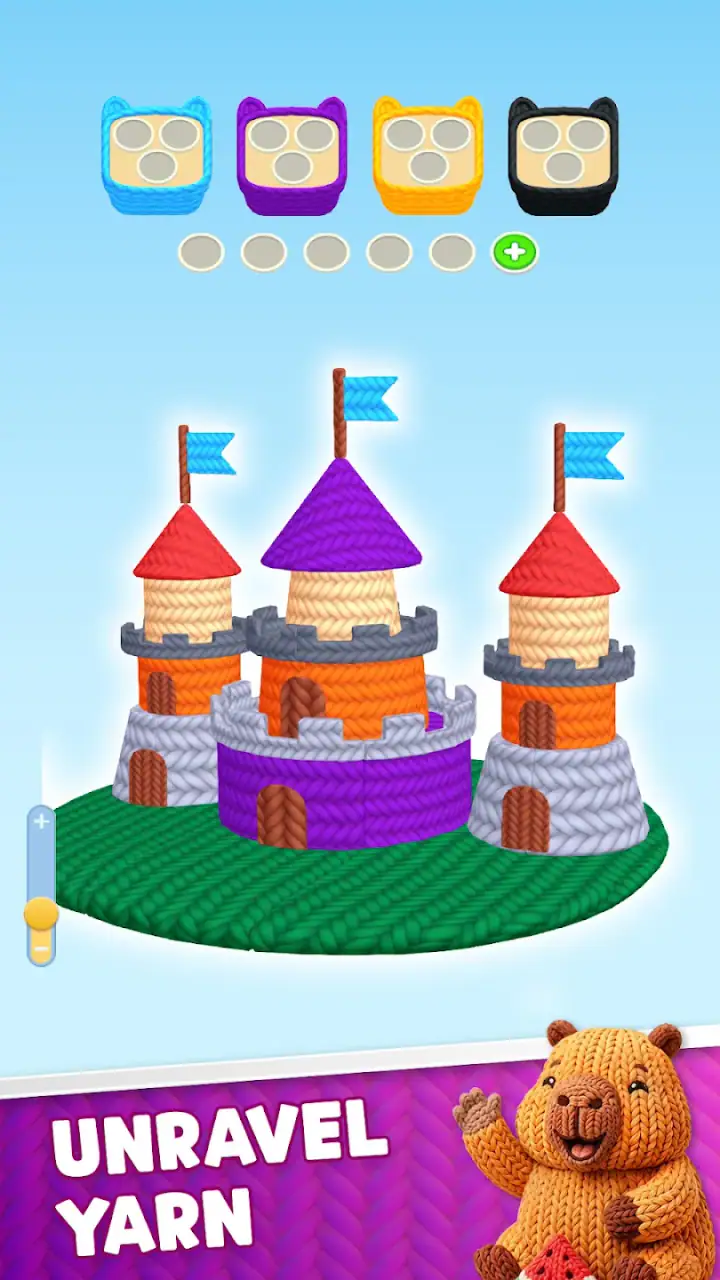
The current release is version 1.2, and the game runs on Android devices using version 7.0 or later. That gives it a relatively accessible technical starting point for Android users who are not carrying the newest phone. I would still judge the experience on the actual device rather than assume every older handset will feel identical, especially with a three-dimensional visual style, but the minimum system requirement is not unusually demanding.
Why the first week works
During the first week, the main reward is learning how the puzzles think. I begin to recognize that a good move is not necessarily the loop closest to the edge or the most noticeable color. Sometimes the correct choice is the piece that blocks several others. Removing it can transform the whole board, while grabbing an easy-looking loop may leave the important area just as tangled as before.
That makes the game more satisfying than a purely reflexive tapper. I can improve through attention rather than faster fingers. A useful approach is to identify two or three possible moves, then compare them by asking which one opens the most space. This small planning step is a concrete way to make the puzzles feel less trial-and-error and more deliberate.
There is also a nice emotional payoff in the final part of a board. Once the central obstruction is gone, the remaining yarn can become much easier to understand. The visual cleanup provides a clear sense of progress, which is why the game is particularly effective when I need a short mental reset. It gives me a defined task and a visible ending instead of an endless feed.
However, the novelty is tied closely to the pleasure of seeing the first patterns. Players who already know they dislike untangling, sorting, or spatial puzzles may not discover a hidden action game underneath. The concept stays focused. That focus is a strength for the right audience, but it also means the first-week appeal may be brief for anyone looking for constant genre changes.
What remains useful after the novelty fades
The more important question is whether the game earns a lasting place on my phone after the initial curiosity disappears. My answer is qualified but positive. It has recurring value as a compact relaxation game, especially for people who enjoy small, self-contained challenges. I can return to it when I want a quiet activity that does not require a large commitment or a detailed memory of what happened previously.
Its long-term role is therefore closer to a puzzle habit than a main game. I would not expect it to replace a deep logic title, a narrative adventure, or a competitive game. Instead, it works as a dependable option for the spaces between those experiences. If I keep it installed, it is because the yarn theme and three-dimensional arrangements offer a distinct visual texture compared with standard tile, word, or number puzzles.
A realistic everyday use case is a short break after work. I might play one or two boards while having coffee, using the need to inspect the loops as a way to shift attention away from emails. The game is well suited to that moment because I can focus on one immediate problem without investing in a larger campaign. It also works before bed for players who prefer calm visual reasoning to fast reactions, although anyone who finds puzzle completion mentally stimulating may prefer not to use it when trying to wind down.
Another useful habit is to stop after a satisfying solve rather than continue automatically. Because the core loop is easy to understand, it can encourage “just one more” play even when the session has already served its purpose. I get more value from it when I treat it as a short mental exercise instead of an endless obligation. That distinction matters for a game whose appeal depends on freshness and concentration.
The public response suggests that the game has found an audience, with a 4.7 average from around 13 thousand ratings and more than 100 thousand installs. Those numbers make it easier for me to view the title as an established casual choice rather than an unknown experiment, while they do not change the personal question of whether its particular style suits me.
Unico Studio’s design choice is sensible for repeat visits: the individual puzzle is understandable without a long tutorial, and the yarn arrangement gives the familiar untangling idea a recognizable identity. Still, recurring value depends on how much I enjoy the act of inspecting similar visual problems. If I need new mechanics, story developments, or social competition to stay interested, the game is less likely to become a permanent fixture.
Where the maintenance burden appears
Maintenance is not only about updates or storage. For this game, it is mainly the effort required to keep the experience feeling fresh. I need to bring some patience to each session, because the pleasure comes from solving the arrangement rather than from a constant stream of surprises. When I am tired and want immediate stimulation, the careful visual reading can feel like work instead of relaxation.
The free entry point lowers the barrier to trying it, but the purchase structure adds a practical responsibility. Optional items cost between $0.99 and $99.99, so I would check purchase controls before allowing a child to play independently. I also would not buy anything simply to remove the normal thinking process unless I had already decided that convenience mattered more to me than the puzzle challenge. The game’s main value is solving, and spending can potentially weaken that value if used too quickly.
My preferred maintenance routine is simple: play in short sessions, avoid tapping through boards without looking, and take a break when the arrangements begin to blur together. That helps preserve the feeling of discovery. I would also keep expectations realistic about the game’s place in my library. It is easy to maintain as a casual backup, but I would not force myself to play daily just to turn it into a habit.
Device compatibility is another small consideration. Android users need version 7.0 or later, and the three-dimensional presentation means the experience may feel more comfortable on a screen where loops are easy to distinguish. A smaller or older device may still meet the software requirement, but I would pay attention to visibility and touch accuracy during a trial session. Those factors matter more here than they would in a simple text puzzle.
The age rating of Everyone makes the game broadly suitable, but suitability does not mean every player will enjoy it equally. A child who likes sorting and visual problems may find it absorbing, while another may become frustrated by a move that looks free but is not. I would introduce it as a thinking game rather than promise effortless entertainment.
What can cause fatigue over time
The main source of fatigue is repetition in the central action. Untangling yarn is the identity of the game, but it is also the boundary around it. Once I understand the visual language, the surprise comes less from learning new rules and more from facing a new arrangement. That can be enough for a puzzle fan, but players who need dramatic variation may feel that the game has shown its full hand early.
Another possible frustration is the gap between visual confidence and logical certainty. A loop may look like the obvious next move, yet the better solution can require leaving it alone while clearing another obstruction. When I make a wrong choice, the problem is not always that the rule is difficult; sometimes I simply read the pile too quickly. This is fair as a puzzle challenge, but it can feel irritating during a distracted session.
That is why I recommend using a deliberate scanning method. First, I look for pieces with the least visual interference. Next, I check whether removing one of them would expose a larger blocked area. Finally, I choose the move that improves the board’s overall readability, not merely the one that produces the quickest visible result. This workflow reduces careless moves and gives the game more depth than random tapping.
The other fatigue point is monetization pressure. The game is free, and optional purchases are part of the experience, so players who strongly prefer one-time purchases or completely uninterrupted free play may be more comfortable with a premium puzzle alternative. I would choose another option if I knew that purchase prompts, optional boosts, or similar interruptions would bother me more than the yarn puzzles entertain me.
Compared with word games, this title asks less from language and more from visual-spatial attention. Compared with number puzzles, it is more physical and immediate but may offer less analytical variety. Compared with match-three games, it is calmer and more deliberate, with less emphasis on chain reactions or speed. Those differences make the choice fairly clear: I would pick Yarn Out 3D for visual untangling and short logic sessions, but a different category is better if I want vocabulary practice, mathematical deduction, or fast arcade feedback.
I would also skip it if I want a strong narrative reason to return. There is no need to invent a story around the yarn; the satisfaction is in the board itself. That is perfectly acceptable for a focused puzzle, but it means the long-term motivation must come from solving rather than emotional attachment to characters or a world.
Who should keep it installed
I think the game is a good fit for casual puzzle players who enjoy cleaning up visual disorder, planning a few moves ahead, and playing in compact sessions. It is especially suitable for someone who wants an approachable three-dimensional logic game without the pressure of timers, competition, or complex resource management. The Everyone rating also makes it a reasonable shared-device choice when purchases are managed responsibly.
I would recommend it to a friend who often says they want a game for waiting rooms or quiet breaks. The yarn theme gives it more personality than a generic grid, and the interaction is easy to understand after a brief look. My practical advice would be to play slowly at first, identify the piece that blocks the most routes, and resist the urge to remove the most obvious loop immediately.
I would not recommend it as the only puzzle game on a phone for someone who needs constant novelty. Its lasting value comes from the quality of its focused loop, not from being a broad collection of unrelated activities. Nor would I choose it for someone who wants a fully paid, interruption-free experience from the start. In those cases, a premium alternative may be a better match, even if it lacks the distinctive yarn-based presentation.
The developer, Unico Studio, has positioned the game in a comfortable middle ground: more visually distinctive than a basic sorting exercise, but easier to enter than a demanding abstract logic title. That balance explains why it can work for a wide audience. It also explains why the game may not satisfy specialists who want deep systems or players who need a constant sense of progression beyond solving the next arrangement.
My long-term verdict
After the first-week curiosity fades, Yarn Out 3D remains worthwhile as a small, repeatable puzzle companion rather than a game I would build my entire free time around. Its best qualities are the readable goal, the tactile feeling of clearing tangled loops, and the way three-dimensional placement encourages careful observation. I appreciate that improvement comes from learning to inspect the board, not from memorizing a complicated rulebook.
Its limitations are equally clear. The focused concept can become repetitive, visual puzzles are not ideal for every mood, and the optional purchase range means I would manage spending carefully. Players who want story, competition, or a wide selection of mechanics should look elsewhere. Even fans of the genre may eventually use it in rotation with word, number, or premium logic games to avoid fatigue.
For me, the title earns lasting space when I treat it as a purposeful short-session game. I open it when I want to untangle something concrete, settle my attention, and finish with a visible result. I would keep it installed for that reason, especially because it is free to try and has a broad age rating. Its long-term strength is not endless novelty, but the dependable satisfaction of making a confusing yarn arrangement readable again.
In short, this is a focused puzzle game with a clear personality. It will not suit everyone, and it does not need to. If you enjoy visual logic, prefer calm problem-solving, and can accept a repeatable core loop with optional purchases, it is an easy one to try. If you need richer progression or a completely different kind of challenge, your storage space is probably better reserved for another genre.
FAQs for Yarn Out 3D
What is Yarn Out 3D and how does the gameplay work?
Yarn Out 3D is a casual puzzle game centered on untangling colorful strands of yarn. Each level presents a three-dimensional arrangement of tangled threads, pins, or obstacles, and your objective is to move pieces in the correct order until everything is separated. The early stages are easy to understand, while later puzzles require more planning, patience, and careful observation before making a move.
Is Yarn Out 3D suitable for children and beginners?
The game is generally approachable for beginners because its controls are simple and the basic objective is explained quickly. Its colorful visual style and short levels can also appeal to younger players. However, some later puzzles may require logical thinking and concentration, so children may occasionally need assistance. Parents should also review the app’s age rating, advertisements, and in-app purchase settings before allowing regular play.
Does Yarn Out 3D require an internet connection to play?
Yarn Out 3D is designed primarily as a casual, pick-up-and-play experience, and many puzzle sessions can usually be enjoyed without a constant internet connection. Nevertheless, online access may be requested for advertisements, analytics, updates, rewards, or other optional features. Availability can vary depending on the version installed and the device, so checking the store listing and testing airplane mode is recommended.
Are there advertisements or in-app purchases in Yarn Out 3D?
Like many free-to-download puzzle games, Yarn Out 3D may include advertising, particularly between levels or when players choose to receive optional rewards. Depending on the version, it may also offer in-app purchases connected with removing ads, obtaining hints, or unlocking other conveniences. Before downloading, review the current Google Play or App Store information and use parental controls if children will be playing.
What should I know about performance, storage, and downloads before installing it?
Yarn Out 3D is a relatively lightweight casual game compared with graphically intensive 3D titles, but performance can still depend on your phone or tablet’s age, available memory, and operating-system version. Make sure the device has enough free storage for the initial installation and future updates. If the game feels slow, closing background apps and installing the latest official version may help.
Pros
- Simple drag-and-sort controls are easy for new players to understand.
- Short levels make it convenient for quick gaming sessions.
- Colorful 3D visuals give the puzzles a cheerful
- polished look.
- Gradually harder layouts provide a smooth learning curve.
- Offline play is useful when you have no internet connection.
Cons
- Later levels can feel repetitive once the sorting pattern becomes familiar.
- Some puzzles may rely more on trial and error than strategic planning.
- Ads can interrupt the experience
- especially between completed levels.
- The game may use noticeable battery power during longer sessions.
- Players seeking deep progression may find the overall gameplay limited.


